
About ACT for UHC
The Global UHC Action Tracker (ACT for UHC) provides access to the evidence needed to track the implementation of some key commitments adopted in the Political Declaration of the 2023 United Nations General Assembly high-level meeting on universal health coverage (UHC). Like its predecessor, the State of UHC Commitment, it seeks to answer the question: Are countries acting on their commitments to UHC?
ACT for UHC enhances accountability by identifying gaps and progress on implementation of commitments, while serving as a powerful advocacy tool to call for more and better action to make health for all a reality.
UHC2030’s tracking approach
UHC2030’s tracking approach provides a unique perspective that broadens the scope of monitoring progress towards UHC by reflecting on the political dynamics that impact health services and by elevating the voices of people struggling to access health services. Its aim is to provide evidence to inform advocacy and policy making, support collective action, and drive positive change.
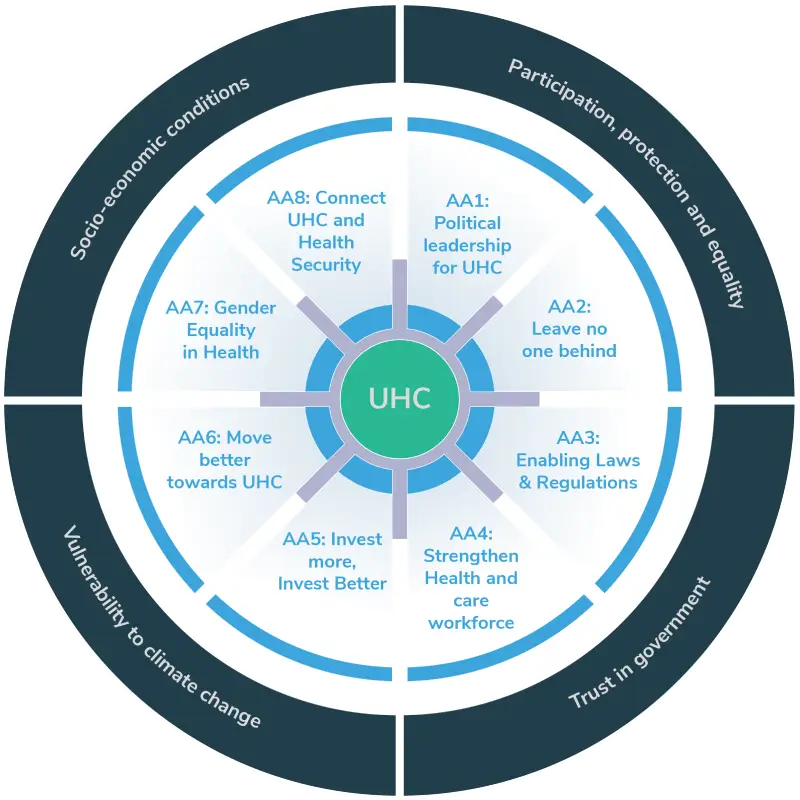
UHC2030’s tracking efforts are anchored in its analytical framework, which maps out some key political commitments endorsed by Heads of States and Governments at the 2023 United Nations high-level meeting on UHC through the lens of stakeholders’ priorities presented in the Action Agenda from the UHC Movement. Relevant indicators were carefully selected to assess progress on the implementation of commitments and they are structured into the eight action areas of the UHC Action Agenda. The framework also reflects broader contextual factors that influence the implementation and advancement of UHC in each country.
Purpose of ACT for UHC
Monitoring progress towards UHC and holding governments accountable requires multi-dimensional data collected within and beyond the health system, including on political dimensions such as rights, governance and equity. To this end, UHC2030’s tracking efforts aim to:
- Present evidence and information to track progress on the implementation of UHC commitments.
- Identify gaps and challenges in implementing UHC commitments, with a focus on understanding who is left behind and why.
- Formulate evidence-based advocacy messages to call for more and better action to deliver on UHC commitments.
- Support evidence-based law- and policy-making to accelerate progress towards UHC and health for all.
Overall, the UHC2030 tracking tools are designed to complement other UHC monitoring efforts, such as the WHO and World Bank Group’s Tracking Universal Health Coverage: Global Monitoring Report.
Characteristics of UHC2030’s tracking approach
For any queries regarding this dashboard, please contact us. View licences & credits.
About UHC2030
UHC2030 is a global, multi-stakeholder platform for accelerating sustainable progress towards universal health coverage (UHC). Its vision is a world where all people have access to the full range of quality health services they need, when and where they need them, without financial hardship. Our members are the leading voices of the UHC movement, spanning countries, civil society, the private sector, foundations, UN agencies and other international organizations that are working collectively to build equitable, resilient health systems that leave no one behind and that provide the foundation for achieving health security.
The UHC2030 Secretariat is hosted by the World Health Organization (WHO) in collaboration with the World Bank and the Organization for Economic Cooperation and Development (OECD).
For more information, please visit: Taking action for universal health coverage - UHC2030.